






 Spell
 Normal
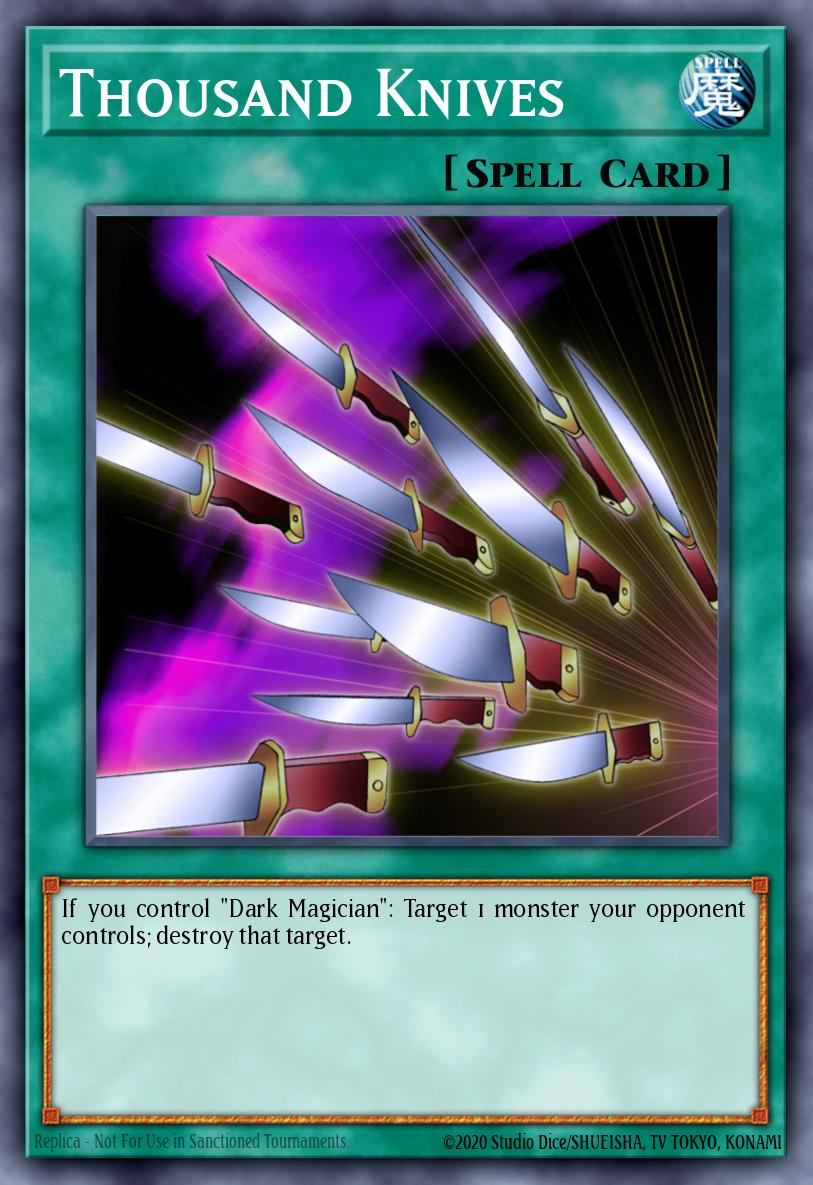
Thousand Knives
Archetype:
Dark Magician
View:
7090
If you control "Dark Magician": Target 1 monster your opponent controls; destroy that target.
Thousand Knives — Power Evaluation
Final Score: 55 ± 6 · Confidence: Medium
- Intrinsic: 55.6 · Deck: 55.4 · Meta: provisional
- Primary role: Removal / Negation
Why it scores here
Thousand Knives converts an active Dark Magician into one targeted destruction of an opposing monster, a 1-for-1 exchange with no body, material or follow-up. Its heavy deck usage (398 of 398 decks, 92% co-occurring with Dark Magician) confirms it is a staple inside that ecosystem, but that popularity is not treated as intrinsic power. The Dark Magician requirement and the single-target result keep the score in the mid-range, and its high ATK-independent deck fit is what lifts it above a pure niche card.
Axis scores
| Axis | Score | Evidence |
|---|---|---|
| Accessibility | 70 | The card is a spell that needs Dark Magician face-up on the field, and Dark Magician is in nearly every attached deck (92.2% co-occurrence), so the condition is usually met (observed). |
| Combo & Conversion | 30 | It destroys one monster and adds no board presence; with no combo boards recorded, conversion is text-only inference (inferred). |
| Resource Economy | 50 | Spell-for-monster is an even 1-for-1 trade with no refuel or draw, so it sits at roughly neutral (verified). |
| Effect & Interaction | 62 | Targeted destruction of any opposing monster is useful disruption, but it is a single-target sorcery-style answer with no negation (verified). |
| Material Utility | 0 | A spell card cannot be used as Fusion, Synchro, Xyz or Link material, so the body contributes nothing (verified). |
| Resilience & Flexibility | 35 | Its condition is Dark Magician on the field, so removing or negating that monster shuts the card off, and it has no recovery route (inferred). |
| Deck-Building Efficiency | 78 | It is one slot, usually run at 1 copy (avg 1.26, 313 of 398 decks at one copy), with no garnet or lock; the Dark Magician condition is a play restriction rather than a deck-building cost (observed). |
Calculation
Weight profile: Removal / Negation profile, single primary role, no secondary blend. Intrinsic ≈ 55.6, Deck ≈ 55.4, Meta = provisional. Modifiers: Named-card dependency (-3). Final formula: 0.40*Intrinsic + 0.60*Deck
Strengths
- One-card answer to any opposing monster, so it is flexible against bosses
- Near-universal inclusion in its Dark Magician home (398 decks), so accessibility is high in that shell
- Single copy slot with no garnet cost
Weaknesses
- Requires Dark Magician on the field, so it is dead without that board state
- Pure 1-for-1 with no card advantage or body
- No material value and no negation of the opponent's effects
Counters / choke points
- Responding to the removal or negating the activation is possible if the opponent holds interaction, since the evidence supplies no specific counter cards
- Removing or negating the Dark Magician on the field turns the card off
Best use
Single-target removal enabled by Dark Magician on the field. Decks: Dark Magician core decks (archetype 670, 116 decks), Dark Magician variant decks (archetype 165, 44 decks; archetype 499, 15 decks), Magician Girls builds (19 decks). Suggested copies: 1.
Evidence & gaps
- Verified: Card text: if you control Dark Magician, target 1 monster your opponent controls and destroy it; Card is a Spell Card with no material use; 398 of 398 attached decks run it; average 1.26 copies per deck
- Observed: Dark Magician co-occurs in 92.2% of attached decks; Usage concentrated in Dark Magician archetypes (ids 670, 165, 499) and Magician Girls; No combo boards record the card, so no starter, searched, material or payoff frequencies
- Inferred: Acts as a sorcery-speed single-target answer, since no Quick-Play marking appears in the type data; Value is conditional on Dark Magician staying on the field, which the text makes explicit
- Data gaps: no combos supplied, so combo conversion is text-only inference no banlist token, assumed 3 copies (unlimited) no usage statistics (StatisticsCard), so archetype inclusion is inferred from the deck sample only Normal versus Quick-Play timing is not stated in the evidence Several archetype names repeat under different ids, so distinct archetypes overstates portability